Search Thermo Fisher Scientific
Disclaimer

Clicking the images or links will redirect you to a website hosted by BenchSci that provides third-party scientific content. Neither the content nor the BenchSci technology and processes for selection have been evaluated by us; we are providing them as-is and without warranty of any kind, including for use or application of the Thermo Fisher Scientific products presented.

FIGURE: 1 / 2
KCNQ5 Antibody (PA1-941) in ICC/IF, IHC
Molecular pain 2018 -
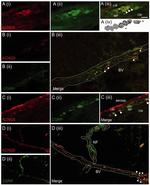
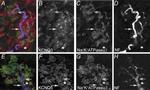
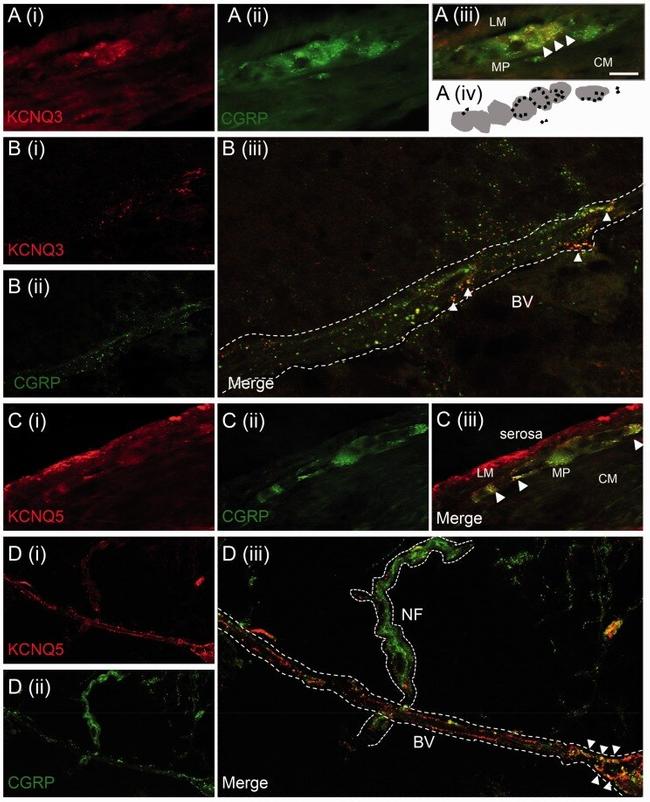
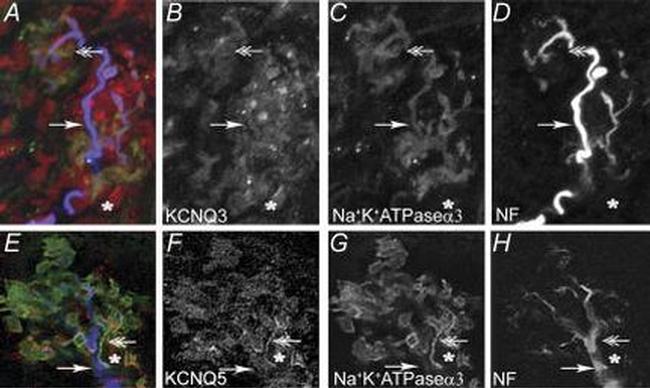
Figure 1. Expression of K V 7 channels in mouse colon and mesenteric neurovasculature. (a) K V 7.3 co-expression with CGRP-positive neurons within the myenteric plexus (MP) of mouse colon (tissue sections). Panel (iv) is a schematic representation of endings that co-label for CGRP and K V 7.3 (in black) surrounding neuronal cell bodies (in grey) of the myenteric plexus. (b) In the mesentery associated with ... View More
Product Details
PA1-941
Applications
Tested Dilution
Publications
Product Specifications
Species Reactivity
Human,
Rat
Published species
Mouse,
Rat
Host/Isotype
Rabbit
/ IgG
Class
Polyclonal
Type
Antibody
Immunogen
Synthetic peptide corresponding to residues C(880) K A G E S T D A L S L P H V K L K(897) of human KCNQ5 protein.
Conjugate
Unconjugated
Form
Liquid
Concentration
1 mg/mL
Purification
Antigen affinity chromatography
Storage buffer
PBS with 1mg/mL BSA
Contains
0.05% sodium azide
Storage conditions
-20° C, Avoid Freeze/Thaw Cycles
Shipping conditions
Wet ice
RRID
AB_2131842
Product Specific Information
PA1-941 detects the KCNQ5 from rat and human samples. This antibody is specific for KCNQ5 and does not detect KCNQ1, KCNQ2, KCNQ3 or KCNQ4.
PA1-941 has been successfully used in Western blot procedures. By Western blot, this antibody detects a ~125 kDa band representing KCNQ5 from rat brain extract.
The PA1-941 immunizing peptide corresponds to amino acid residues 880-897 from human KCNQ5.
Target Information
KCNQs are members of the voltage-dependent non-inactivating potassium channel family. Currently there are five known KNCQs (KCNQ1-5) found in the central nervous system. Studies have shown that KCNQ3 and KCNQ5 form heteromultimers that, when formed, substantially increase the M-current. Inhibition of M-current controls neuron excitability throughout the nervous system as well as the responsiveness to synaptic inputs. Genetic mutations in these proteins have been linked to disorders such as benign familial neonatal convulsions (BFNC), deafness, neuropathic pain and epilepsy. Voltage-dependent potassium channels are key regulators of the resting membrane potential and modulate the excitability of electrically active cells. The channels are usually tetrameric and can interact with auxiliary subunits that enhance or modify currents mediated by the pore-forming subunits.
For Research Use Only. Not for use in diagnostic procedures. Not for resale without express authorization.
Bioinformatics
Protein Aliases: KQT-like 5; KvLQT5; potassium channel protein; Potassium channel subunit alpha KvLQT5; potassium channel, voltage gated KQT-like subfamily Q, member 5; Potassium voltage-gated channel subfamily KQT member 5; potassium voltage-gated channel, KQT-like subfamily, member 5; potassium voltage-gated channel, subfamily Q, member 5; rCG_43583; Voltage-gated potassium channel subunit Kv7.5
Gene Aliases: KCNQ5; Kcnq5l; Kv7.5
UniProt ID: (Human) Q9NR82
Entrez Gene ID: (Human) 56479, (Rat) 259273
Molecular Function:
 ion channel
transporter
voltage-gated ion channel
ion channel
transporter
voltage-gated ion channel

Performance Guarantee
If an Invitrogen™ antibody doesn't perform as described on our website or datasheet,we'll replace the product at no cost to you, or provide you with a credit for a future purchase.*
Learn more
We're here to help
Get expert recommendations for common problems or connect directly with an on staff expert for technical assistance related to applications, equipment and general product use.
Contact tech support